ABOUT US
  RESEARCH
  PEOPLE
  PUBLICATIONS
  CONTACT
  LINKS
  GALLERY
  WEB MAP
  HOME
Synthesis of P-stereogenic phosphines
Applications in asymmetric catalysis

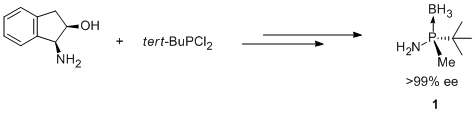
Chiral phosphines play a key role to attain high activity and selectivity in asymmetric catalysis. As a consequence a great effort has been devoted to develop efficient phosphine ligands for any catalytic process. Among these, P-stereogenic phosphines have shown to be very proficient in asymmetric hydrogenation and other industrially relevant processes. In this context, our group has developed a synthesis for novel P-stereogenic aminophosphine synthons (1) bearing a primary amino group. These compounds are easily prepared in optically pure form on large scale using cis-1-amino-2-indanol as chiral auxiliary.


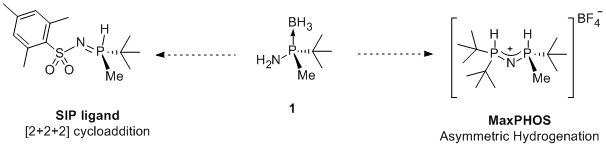
We have recently described the utility of the P-stereogenic aminophosphine building block 1 in the synthesis of N-sulfonyl secondary iminophosphoranes (SIP) type of ligands. The presence of the NH group bounded to a bulky electron-rich phosphine brings about the opportunity for the NH/PH tautomerism to take place. The tautomeric equilibrium is shifted towards the P(V) form thus protecting the phosphorus atom from oxidation. We have demonstrated that SIP ligands are valuable in the Rh catalyzed asymmetric [2+2+2] cycloaddition of endiynes. Building block 1 has also been used for the synthesis of the MaxPHOS ligand. MaxPHOS has demonstrated to be an efficient ligand in the Rh catalyzed asymmetric hydrogenation. The ligand is most conveniently isolated as its HBF4 salt which is an air stable solid.